






Pralhad Joshi, Union Cabinet Minister of Consumer Affairs, Food and Public Distribution and New and Renewable Energy, on the BJP electoral wins in Assam and West Bengal, the impact of the US-Iran war on the renewable energy sector and his party’s stand on women’s quota and delimitation. The session was moderated by Harikishan Sharma, Senior Assistant Editor, The Indian Express.
Harikishan Sharma: In the recent Assembly elections, your party did extremely well in the eastern states. What worked in your favour?
As far as Assam is concerned, it was good governance. If your intentions are good, if you are here for the welfare of the people and work honestly, ultimately, this is the outcome. Just look at the Congress party. People are now questioning why they should vote for the Congress. Its arrogance has become the party’s unbecoming. In West Bengal, it was an anti-incumbency sentiment — against arrogance and harassing people, no law and order. People were really fed up. They were never allowed to vote. But this time, the administration, especially, the Election Commission, made arrangements for free and fair voting, so people came out and voted — 93 per cent did. Especially in this era of technology, things cannot function like before when anyone could come and stamp their vote. This time the strategy was different, some of the ministers were sent there. There was effort put in and there were follow-ups. After the last Lok Sabha elections, there was always someone (from the BJP) who went regularly. Whenever the TMC rowdies would attack people, we would go there and console people. The Home Minister was there for more than 15 days and would work the entire day. This is the type of killer instinct we had. We felt in the larger interest of the country, BJP should win West Bengal. This is the difference between BJP and other parties.
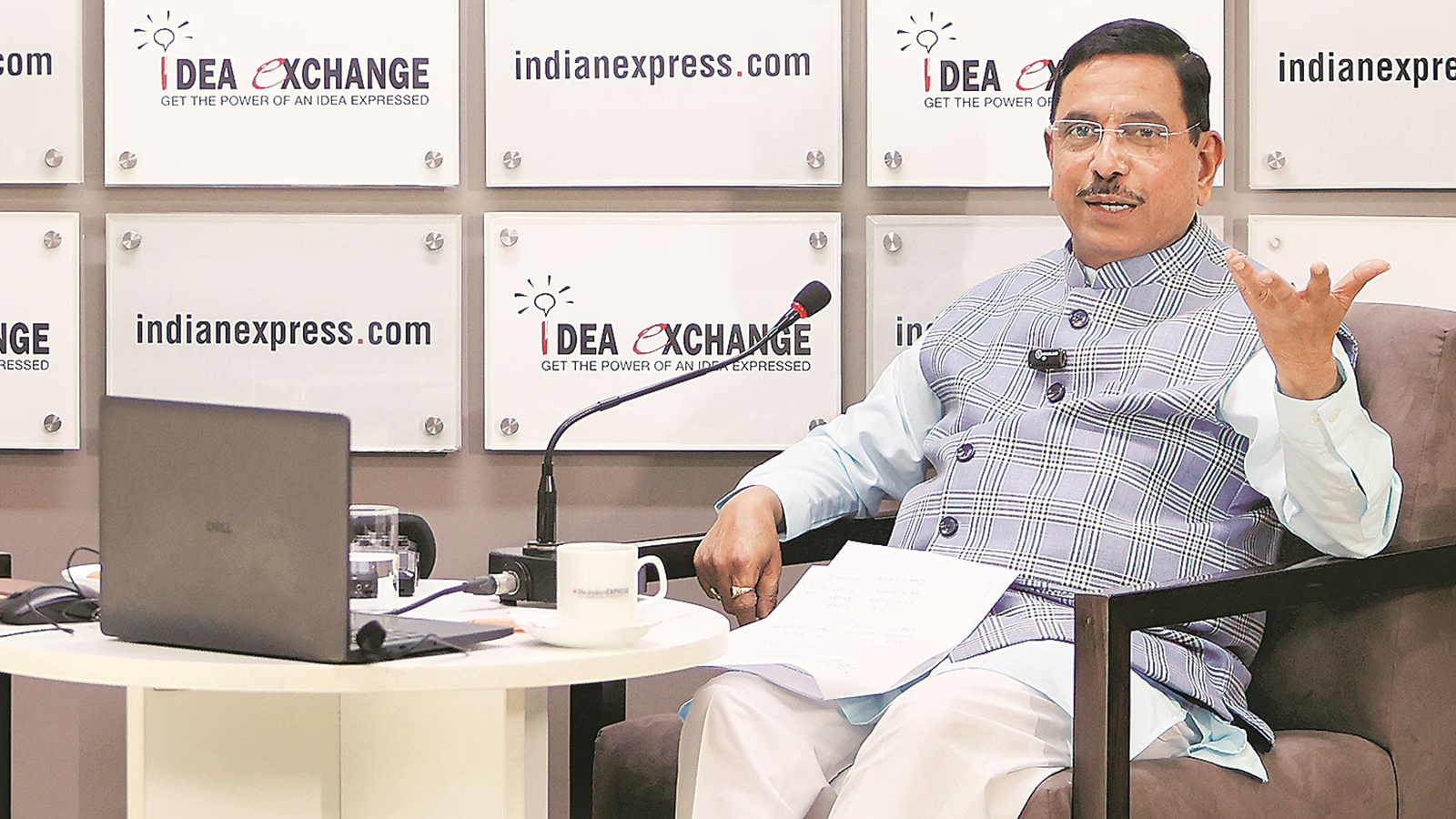
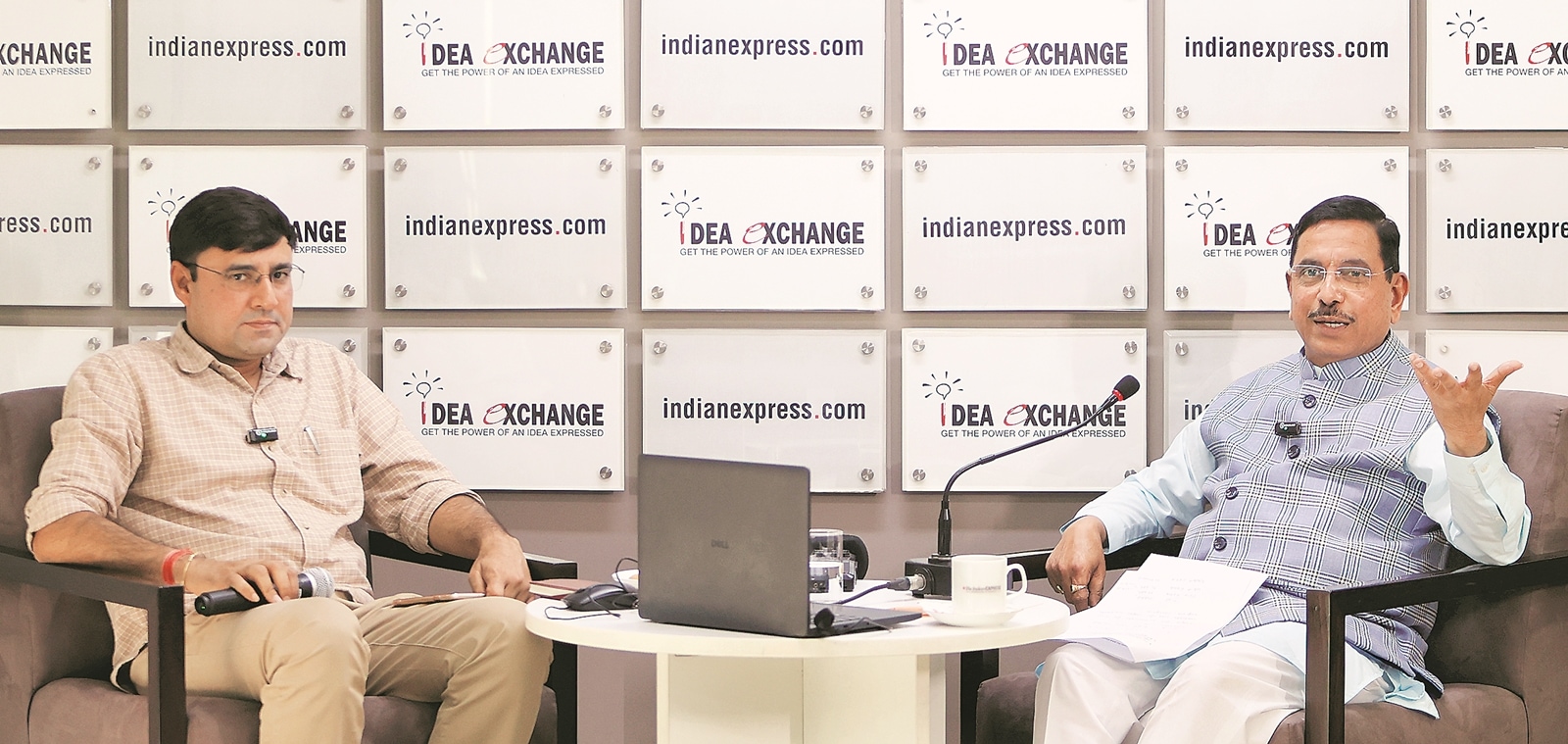 Pralhad Joshi, Union Cabinet Minister of Consumer Affairs, Food and Public Distribution and New and Renewable Energy (right) with Harikishan Sharma, Senior Assistant Editor, The Indian Express. (Express Photo by Gajendra Yadav)
Harikishan Sharma: Earlier this year, you launched the Central Bank Digital Currency (CBDC)-based Food Subsidy Distribution project in Puducherry. Are there plans to expand the pilot project to other parts of the country?
The thinking behind CBDC was to roll it out in the entire country. When we do a new experiment, we want to understand what difficulties may arise and how we should address them. We started with some 70,000 households in Gujarat, now the number is up to around 2,32,000. This is the best example of how digital India can transform lives. It is the most transparent system and pilferage will decline. Of course, there are people who will mess things up but as a system we want to make it foolproof and that’s why after Aadhaar, we have brought in biometric iris. Today, 99 per cent of the ration cards have been digitised and 100 per cent ration shops too. The EPOS (Electronic Point of Sale) machines and weighing machines have been digitised and linked up to 60-65 percent.
Harikishan Sharma: In the last fiscal year, the food subsidy was well above Rs 2 lakh crore. Official estimates show that extreme poverty has come down to 5 per cent while you continue to provide food grains to 81 crore people. Don’t you think it’s time to discuss changes in the National Food Security Act to reflect this reality, because there may not be so many people who need this subsidised food grain?
The Prime Minister himself has given a reply in Parliament. From 2014 to 2019, there were changes brought into the overall system. From 2019 to 2024, actual reforms and welfare schemes for people were perfectly executed. From 2019 to 2024, numbers show that multidimensional poverty has come down. Nearly 25 crore people have come out of poverty. Whatever they are saving because of the Pradhan Mantri Garib Kalyan Anna Yojana, they are spending it on their children, on milk and eggs or education. The idea of Viksit Bharat is not only building infrastructure but also about people’s welfare. I have also categorically told state governments that if people do not want ration, cancel their card. And that this ration card should not be used as a proof of document for any other thing, so that we can streamline the system.
Story continues below this ad
Vikas Pathak: In the SIR exercise in Bengal, 27 lakh voters names got deleted on grounds of logical discrepancy. They were supposed to go to the appellate tribunals to get their names restored but that could not happen for want of time. But around 1,600 names were restored. Since we have universal adult franchise, what do you think is the constitutional impact because there may be lakhs of voters who were eligible but could not cast their vote?
This exercise was scientifically done. Technology was used. And when Mamata Banerjee went to court, the Supreme Court made all arrangements. Under its supervision, judicial officers were appointed. But, based on SIR alone, there is no probability of a party winning. In Tamil Nadu, 90 lakh voters got deleted in SIR. Here it was 97 lakh. Out of that 63 per cent were Hindu votes. There is nothing to hide about the fact that some Muslims are either with Trinamool or Congress. They don’t favour the BJP. We are not against them but still it is happening. But of these 27 lakh, it was adjudicated and if they did have a document, they could have presented it at that time. The fact that they could not properly present the document is itself a clear indication that there are some issues. Unless it is proved, you cannot make them vote. Of course, there have been some deletions but there have also been additions across all religions and castes. In 2010, there was a circular that no matter the reason, don’t remove a voter from the list. And we fought over that. Even after an individual’s death, their name wasn’t removed from the list. But I personally believe that if the state government (in West Bengal) would have cooperated from the beginning, the execution wouldn’t have been this delayed.
Nikhil Ghanekar: While the government is promoting the sector of new and renewable energy, there is also a concern whether we are keeping pace with battery storage because a lot of the production does not happen in our country. And while it is touted as a project which is green in nature, the siting of these projects largely happens in areas which are forested. There are concerns that it is happening in the Western Ghats while the draft notification is still pending. Your comments?
We can go for pumped storage (hydropower) plants only where there is a reservoir, dam or river nearby. All environmental considerations are kept in mind while doing that, and still there is a green bench of the Supreme Court which doesn’t permit such actions. So we take a balanced approach keeping both environment and development in mind. If we do something wrong, we will anyway not get permission. These are all autonomous bodies and people will go to the court.
Story continues below this ad
As far as battery storage is concerned, the total hours requirement by 2030 is 411 gigawatt per hour. Before 2014, only 2 gigawatt of modules were produced in India. Through the PLI (Production Linked Incentive) scheme, we will generate up to 44 gigawatt within India itself but we will have to import some raw materials. We need critical minerals and the National Critical Mineral Mission has been started. We are now mining lithium in some places.
Nikhil Ghanekar: Because of the US-Iran war, what is the impact on the renewable sector because of the shocks to the entire sector due to the continuation of coal in the energy basket?
Renewable energy is going to be the real, big solution for this issue. For instance, our total solar capacity today is 150 gigawatt. Recently, peak power demand had reached 256.4 gigawatt. In 2012, during the Manmohan Singh-Sonia Gandhi government, when peak demand was 256 gigawatt, the entire grid collapsed, and north India was in the dark. Today, we have successfully managed 256.4 gigawatt during peak demand in a single day. This says that there is systemic improvement. Of this, 33 per cent was from renewable energy.
So, we are promoting induction stoves and EVs. Our overall figures for EVs have shot up considerably. But, do you really want to become green and want to save money? Then charge your EV during the day. Install solar panels through PM Surya Ghar or rooftop solar on your own, and charge it. It will be less than Rs 1 per km. That means, first, you are saving, then you are helping the environment, and through reduced imports, you are also helping the country.
Story continues below this ad
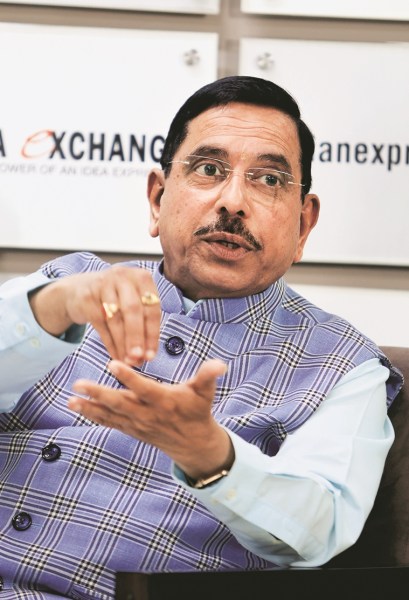 Union Food Minister Pralhad Joshi. (Express Photo by Gajendra Yadav)
Harish Damodaran: We have been exporting about 15 million tonnes of non-basmati rice every year. The average realisation is about Rs 33-34 per kg. How is it possible? In the open market, you don’t get rice at that price. Many believe that it is basically the same PDS rice which is getting diverted. So, is it that in the name of the poor, it is basically all going for exports?
That is why the digital transformation is being done, from biometrics to EPOS and now CBDC, to plug the leaks so that recycling does not happen. There should be accountability. The FPS (Fair Price Shop) shops and state governments are all acting together, we are forcing them to act. We have told the states to continuously raid and catch such practices. We have also issued instructions to the Customs. But we are equally concerned about this.
Pratyush Deep: There has been a growing mismatch between the deployment of renewable energy capacity and the development of transmission infrastructure. This has led to curtailment and transmission constraint. What steps is the ministry taking to synchronise this gap?
Laying a new transmission line takes time because there are a lot of clearances. There is forest clearance, and if it goes through a village or a city, people will protest. We have to work amidst all this. Then, there was a Supreme Court stay regarding the GIB (Great Indian Bustard), which is now settled.
Story continues below this ad
Apart from that, what we are doing is with Green Energy Corridor 1 (GEC-1), which we have almost completed and have provided assistance to state governments. Green Energy Corridor 2 is under implementation, and Green Energy Corridor 3 is now going to the Cabinet. It’s something to the figure of Rs 57,000 crore.
The third thing is battery storage. Battery storage is just starting because our solar generation added 44 GW in a single year. People have now started thinking about what to do with this electricity because it is not available in the evening. So, I have suggested two things to the Power Ministry: can we provide power at a concession for work that can be done between 4 and 5 pm? Like they do in Australia, Switzerland. Can we motivate the states so that whatever work you have — washing clothes, dishes —can you do it before that time, and use the electricity to charge your EVs.
Apart from that, for batteries, I think a Rs 24,000 or Rs 25,000 crore PLI scheme will be given, which is being implemented by the Heavy Industry Ministry, but we are providing the guidelines for solar storage.
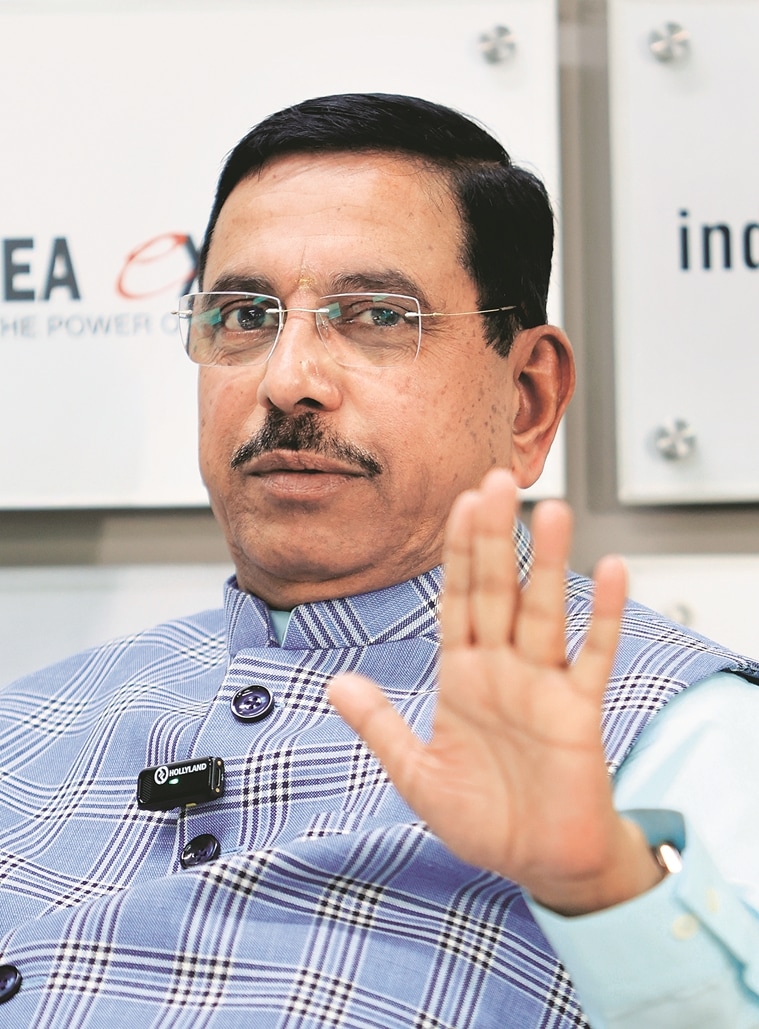 Union Food Minister Pralhad Joshi. (Express Photo by Gajendra Yadav)
Samiksha Mishra: The FSSAI (Food Safety and Standards Authority of India) data shows that over 80 per cent of paneer samples failed the food safety test. What is the ministry doing about that? Are we taking any steps against the big corporations that have been mentioned?
Story continues below this ad
The FSSAI looks after this; it comes under the Health Ministry. But as the Consumer Affairs Minister, and being a consumer myself, I must say our NCH (National Consumer Helpline) has become very popular. We responded to issues immediately. When we received complains about paneer and other items, I wrote to
JP Nadda (Union Health & Family Welfare Minister), and he has acted on it. Samples were taken, raids were done and criminal cases have been filed.
And be it a corporation, a company, or a single small shop owner — the health and welfare of our citizens are paramount. If we receive a complaint that even a corporate hotel is doing such things, we will act immediately.
Sandeep Singh: In Bengal, anti-incumbency was a big factor. Two states that faced huge anti-incumbency were Kerala and Tamil Nadu. Why is it that the BJP has not been able to capitalise on that?
Story continues below this ad
We have made efforts in both the states. As far as my memory goes, since the ’70s, it has been difficult to get elected or convince people outside of the Dravidian parties. In the meantime, we are trying. However, people felt that TVK (a local party) could defeat these two parties. But we will not sit idly just because it hasn’t happened today. Even in states where we had no presence or were a junior partner — like Haryana or Maharashtra — we increased our strength. In some places, we got fast results, some places are a hard nut to crack but we will crack them.
For Kerala, our preparations for the next election and the upcoming Lok Sabha will start now. Modi ji himself is not going to sit quietly regarding the party’s growth, and he isn’t going to let millions of workers like us sit quietly either. Therefore, we will all go to Kerala. In Tamil Nadu, despite the defeat, we have our vote percentage. We will prepare better next time. Earlier, people used to say we won’t win in Bengal, but it has happened. We will now give more thrust toward the southern states.
P Vaidyanathan Iyer: After the election results, the issues of Women’s Reservation and Delimitation seem to have stalled. Do you think they will gain momentum?
For one, those who opposed them have certainly been punished. Let me ask you a question regarding delimitation. Why are seats being increased? You should ask the Congress party why they haven’t conducted local body or BBMP elections in Bengaluru for the last five years. They claim they will do delimitation and increase the number of seats. Why increase them when it has been three years since they came to power and there have been no local body, no zilla panchayat elections held? In my district, they increased the seats from 26 to 27.
Story continues below this ad
Since 1971, the number of seats has remained the same. The population was 55 crore then, today it is 140 crore. In the south, our birth rate is relatively lower because we planned well according to national ambitions. Yet, my constituency still has 21 lakh voters. So why is there a problem with delimitation and increasing numbers. Their opposition was not just about delimitation; their opposition was against women’s reservation.
You can see the record. In 1996, under Prime Minister Deve Gowda with Congress support, they introduced the 84th Amendment Bill but did not allow it to pass. In 1998-99, AB Vajpayee introduced it, but they did not cooperate. In 2009, the UPA passed the Bill in the Rajya Sabha. I was the party whip in the Lok Sabha then, and we were told to support it. But from 2010 to 2014, they did not bring it to the Lok Sabha. In my presence, Sushma Swaraj called Sonia Gandhi and requested her to bring the Bill since we had supported it in the Rajya Sabha. They did not bring it. The inference is that Congress never wanted the Women’s Reservation Bill to be executed. They were never in favour of OBC, SC or ST reservations. This is the proven track record of the Congress party.
P Vaidyanathan Iyer: So you plan to bring it again?
Our leadership will decide that after consultation. But we will never leave it because that is our commitment. Our leadership will decide what best can be done and when it can be done.